A severe harmful algal bloom (HAB) involving Karenia species has affected large areas of the South Australian coastline. The toxicological impacts and impact pathways are poorly understood.
Commonwealth and state agencies identified the need for a detailed understanding of the Karenia species and bloom impacts to enable an improved response to ongoing or future bloom events.
This project is conducting a rapid investigation into the composition, toxicology and variability of the Karenia species bloom across sites, depths, and stages. It involves broadscale water sampling, toxicity assessment (rotifer assays and brevetoxin screening), and identification of species and abundance. A rotifer assay is being developed as a simple and rapid indicator of aquatic water toxicity in relation to harmful Karenia species.
Across these tasks the project team is collaborating with several allied research initiatives associated with the HAB in order to maximise the effectiveness of this research investment.
The project findings may offer the first evidence of how different Karenia species and community structures influence ecological impacts. The new foundational dataset, methodological framework, local capacity and collaboration will support future research, long-term monitoring and marine environmental management.
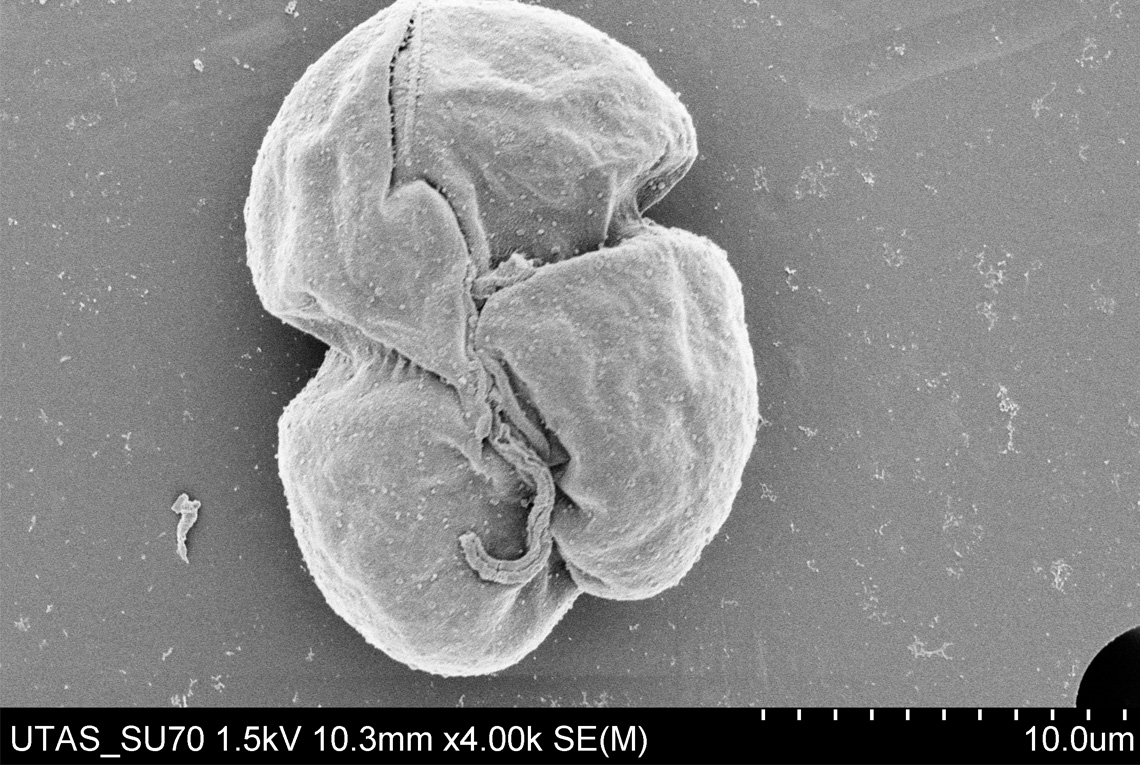
Magnified view of a Karenia strain from South Australia. Image: Gustaaf Hallegraeff
Approach
Broadscale sampling
Water samples are being collected at multiple sites, targetting the leading edge of bloom spread and areas under prolonged exposure across both Gulf St Vincent and Spencer Gulf and Investigator Strait. Sampling locations will be adjusted in response to changes in bloom extent and intensity, guided by satellite chlorophyll maps and other field observations. High-level (non-molecular) microscopic assessments will be conducted on fresh, immobilised material to quantify total Karenia species. Additional samples will be preserved for molecular sampling.
Toxicity assessments
Rotifer bioassays
Bloom samples are being analysed in Adelaide using a rotifer bioassay developed for this bloom. The testing will provide a real-time measure of broad-scale toxicity and allow assessment of spatial and temporal variation across bloom stages.
The assay is sensitive to Karenia species cells and will provide a consistent, comparative index of toxicity across samples. It may not capture all the modes of action relevant to different species, however, so samples will be frozen for future reference and possible analysis.
Additionally, assays are being run with known SA HAB Karenia strains/species isolated by a separate project at University of Technology Sydney (UTS), and with reference species and other HAB cultures from New Zealand’s Cawthron Institute.
Brevetoxin screening
Selected field samples and cultured strains of Karenia species (from UTS) are being screened in collaboration with a SafeFish (Tasmania) project that is piloting ELISA-based screening kits for brevetoxins (toxins of concern). The brevetoxin results will be verified by other accredited laboratories.
Brevetoxin variant(s) involved in the SA HAB are uncertain and likely to be only one component of a suite of harmful compounds being produced by the algae. They may or may not be responsible for the widespread mortalities.
Species identification and abundance
Knowledge of the different Karenia species is critical because they can vary markedly in their toxicity and ecological impacts. Molecular methods are the only reliable way to identify Karenia species, so samples are being sent to UTS for identification and quantification by qPCR.
Analyses carried out on the same samples tested in rotifer assays (and brevetoxin assays) will directly link toxicity with species composition, cross-check against observations, and refine spatial patterns of bloom development.
Expected outcomes
The project will provide SA DEW and the Commonwealth Department of Climate Change, Energy, the Environment and Water and other research users with:
- baseline understanding of bloom toxicity and variability across sites, depths, and stages, linked with qPCR-based species identification;
- a rotifer assay as a simple, rapid indicator of aquatic water toxicity in relation to harmful Karenia species; and
- a foundational dataset, methodological framework, and local, collaborative capacity that links South Australia with national and international HAB research, supporting future studies and long-term monitoring.
Project location
Gulf St Vincent and Spencer Gulf and Investigator Strait, SA.
Project leaders
Shauna Murray
University of Technology Sydney
Gustaaf Hallegraeff
University of Tasmania
Alison Turnbull
University of Tasmania
Andreas Seger
University of Tasmania
Research partners
University of Technology Sydney
University of Tasmania
Research users
SA Department for Environment and Water
Department of Climate Change, Energy, the Environment and Water