
Article
3 June 2026
A case study highlighting Marine and Coastal Hub projects that focus on wetland restoration, blue carbon opportunities, ungulate (hooved animal) management and Indigenous leadership is now available on Adapt Land&Sea.
Adapt Land&Sea is an information and guidance platform to help biodiversity and conservation managers respond to climate change, offering science-based tools and strategies to support adaptation in land and sea management. Still under development, the platform also includes case studies from across Australia to show how managers are considering and undertaking adaptation in real-world settings. The platform is being developed under the National Environmental Science Program and is led by the Climate Systems Hub.
The hub case study, ‘Co-benefit opportunities in northern Australia through wetland restoration carbon projects and nature repair markets’, outlines how restoring wetlands can deliver climate, environmental and social benefits. It draws on interlinked projects (3.8, 3.20, 4.5) that examine how restoring coastal and freshwater wetlands in northern Australia can reduce greenhouse gas emissions, improve ecosystem conditions and create new opportunities for land managers through carbon and nature repair markets.
Many wetlands across northern Australia have been degraded by past land use. Drains and tidal barriers have changed natural water flows. Ungulates, such as pigs and buffalo, continue to damage soils and vegetation. This reduces biodiversity and releases stored carbon into the atmosphere. Restoring wetlands and managing these pressures can help reverse these impacts.
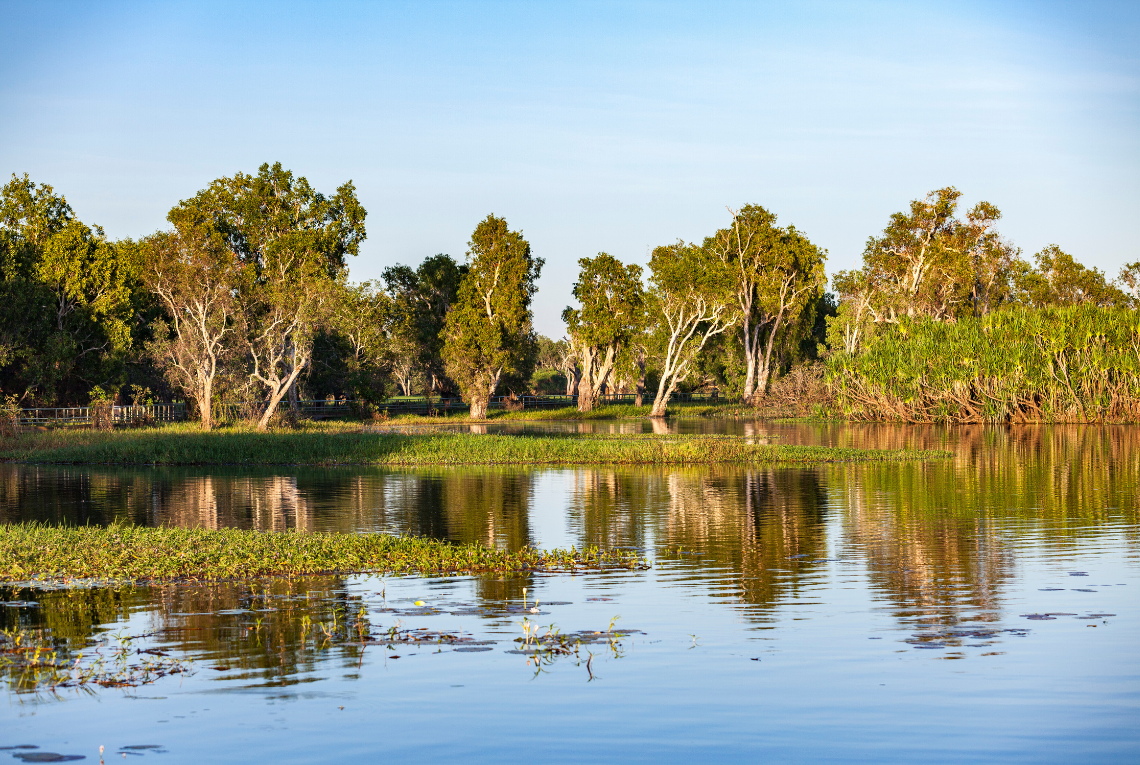
A key focus of the case study is the concept of blue carbon. This refers to carbon stored in coastal and marine ecosystems. The only currently approved blue carbon method for earning Australian Carbon Credit Units (ACCUs) is limited to tidal restoration. This method can work well in areas where tidal flows can be reintroduced. However, many wetlands are affected by other types of disturbance. This limits the number of sites that can access carbon markets.
The case study highlights the potential for ungulate management to become part of future carbon and nature repair approaches. Hub research featured in the case study found that wetlands damaged by ungulates emitted about four times more greenhouse gases than undamaged sites during the early dry season. This suggests that better control of ungulates could deliver dual benefits by reducing emissions and improving wetland health. At the same time, hub research shows that projects with multiple co-benefits are more likely to be economically feasible and attractive under emerging market schemes.
“Managing ungulates offers a practical pathway to reduce emissions and restore wetlands at scale across Australia. Restoring wetlands is about more than just carbon – it is about delivering core benefits for people, Country and climate.”
Professor Catherine Lovelock, University of Queensland
Another major focus is Indigenous leadership. As hub projects have shown, Indigenous organisations manage vast areas of northern Australia and have deep knowledge, strong cultural responsibilities and a major stake in how wetland restoration is designed and delivered. The projects point to the need for clear rights, informed consent, capacity building and long-term support so Indigenous communities can participate fully in carbon and nature repair markets. As the case study concludes, the proposed ACCU Scheme method for wetland repair through ungulate management could create new funding opportunities for Indigenous-led stewardship of Land and Sea Country along northern Australia’s coast, including options not available under the tidal restoration blue carbon method.
Further information
‘Co-benefit opportunities in northern Australia through wetland restoration carbon projects and nature repair markets’ case study on the Adapt Land&Sea website.
Related stories
Article
Blue carbon and environmental markets in Australia: understanding opportunities and risks for Indigenous People
Article
Indigenous-led feral ungulate control offers new pathways for biodiversity and cultural conservation
Article
Taking the loneliness out of coastal restoration
More stories