Article
3 September 2026
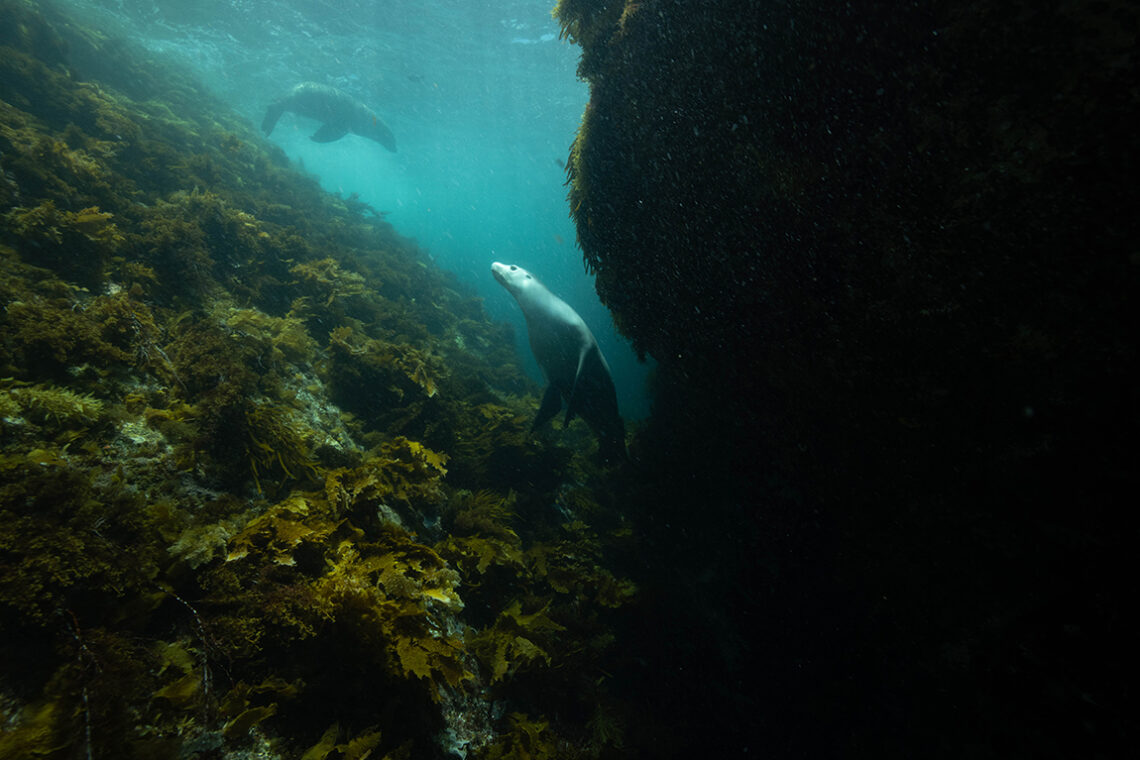
Animal-borne video has enabled scientists to see what Australian sea lions do beneath the ocean’s surface while searching for food. These videos have changed the study of marine megafauna by providing critical information that traditional sensors, such as GPS devices, cannot capture.
But the footage can only cover a small fraction of sea lions’ foraging expeditions, due to camera battery, storage and size limitations. University of Tasmania honours student Ruby Fox developed four machine-learning models to predict where and how sea lions forage when the cameras run out of steam.
Ms Fox used data from a 2022/23 Marine and Coastal Hub project which piloted the use of video and tracking technologies on eight female Australian sea lions from Olive Island and Seal Bay in South Australia.
The dataset comprised more than 162 hours of sea lion-borne video and thousands of datapoints from GPS devices, as well as magnetometers and accelerometers. When used simultaneously, these technologies allowed scientists to capture each animal’s posture and movement in three dimensions.
“It was definitely a big undertaking, but I’m very excited to have used these new technologies to uncover the secret lives of marine mammals,” Ms Fox says. “It was an incredible opportunity to maximise the use of existing data in the most efficient and groundbreaking way.”

Maximising existing data
Dr Nathan Angelakis pre-processed and analysed the imagery and tracking data as part of his PhD project, co-funded by the hub. He identified each foraging event and annotated its success or failure, the foraging tactic, and the prey type. He also reconstructed the sea lions’ movements through dead reckoning, a method that georeferences movement patterns to determine where the individual is and how fast it is swimming.
To extend these findings to the track lines where video was unavailable, Ms Fox synchronised the multiple data streams and standardised the annotations. Then, she used an artificial intelligence approach to create four ‘random forest’ machine-learning models that:
- differentiated foraging behaviours from non-foraging behaviours (for example, travelling or resting);
- differentiated successful and unsuccessful foraging behaviours;
- characterised foraging tactics, specifically if the animal was actively pursuing its prey or probing; and
- identified the prey type: fish, cephalopods or rays.
Put simply, Ms Fox used video-verified tracking data from eight Australian sea lions to ‘train’ algorithms to recognise movement patterns associated with successful and unsuccessful foraging events for distinct prey types.
Similar to wearable smartwatch applications that can predict when a person is walking or travelling by car or bicycle, this project created models to predict foraging behaviours from tracking data alone.
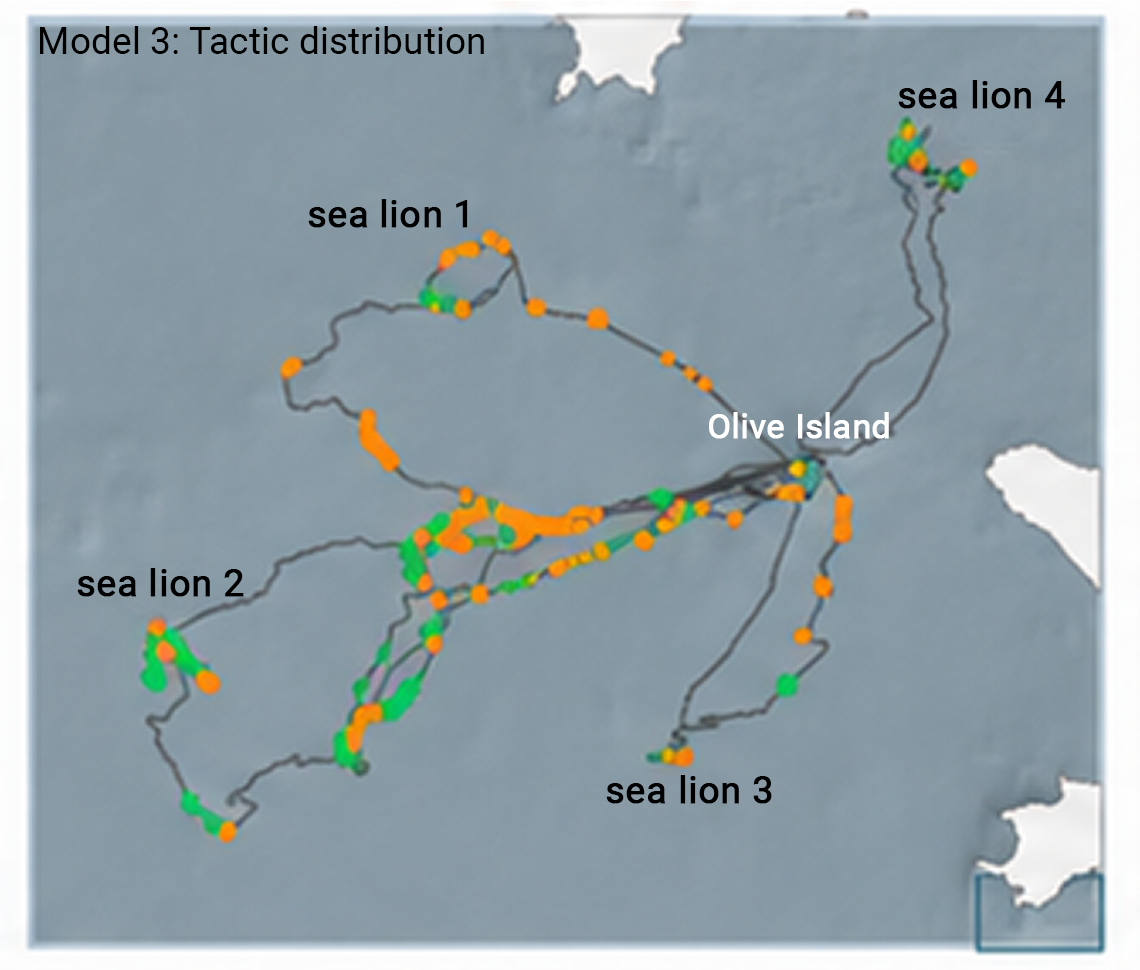
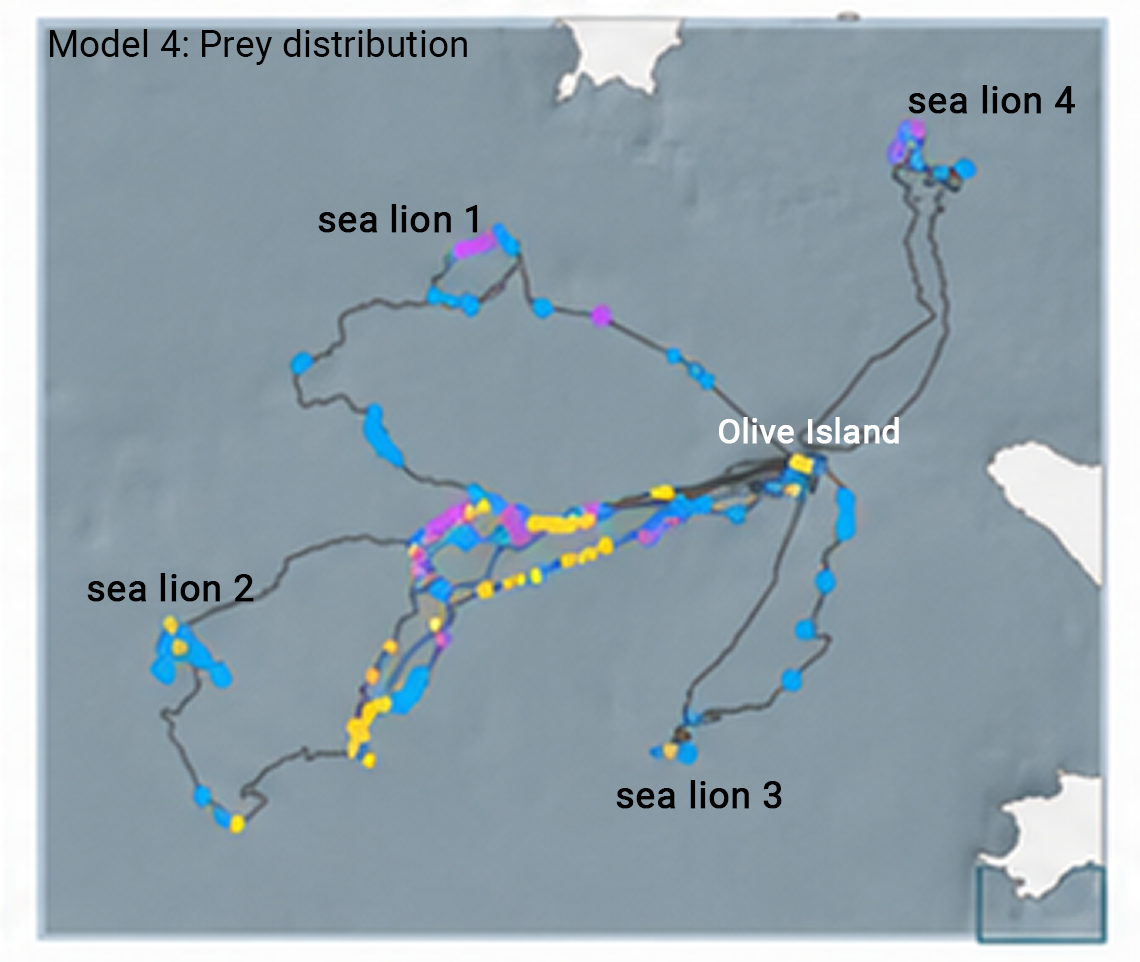
The models showed high accuracy (>99% accuracy) at recognising the behaviour patterns of the individuals they were trained on. When tested on additional ‘unseen’ individuals, however, the models’ predictive performance varied: the foraging behaviour model achieved 91% accuracy; the foraging success model 48% accuracy; the prey strategy model 54% accuracy, and the prey type model 85% accuracy.
This means that the methodology could successfully identify new or continued foraging events for the studied sea lions. The observed variability, Ms Fox says, likely reflects distinct foraging specialisations that other studies have identified in individual female Australian sea lions from different colonies.
What the models found
Given the restricted sample size, the results cannot yet be generalised to males, other colonies or individuals of different age classes (juveniles or pups).
It’s still early days for machine-learning models, but here are some insights from this initial application.
- Female adult Australian sea lions were more successful when catching rays (99%), as opposed to fish (39% successful) or cephalopods (74% successful).
- When targeting rays, 60% of the time sea lions deploy active chase strategies. However, when targeting fish, 65% of the time they employ probing strategies to search in reef, seagrass and sand habitats.
- Each Australian sea lion preferred to target a specific prey type and used consistent tactics to capture and consume it.
- Intensive foraging did not always correspond to foraging success. Sometimes, opportunistic foraging, such as snatching a fish the sea lions stumbled upon while travelling, had higher success rates.
- As shown in other studies, Australian sea lions have a strong preference to return to the same foraging locations (referred to as philopatry or site fidelity).
“We are providing a framework to extend detailed observation data onto the long journeys of many more individuals,” Ms Fox says. “Reviewing camera footage can be intensive and difficult logistically and personnel-wise. This methodology offers a cheaper option for behavioural observation.
“In future, the models may be useful for marine park management, as they provide information on core foraging habitats for the species and its different populations.”
Ongoing research
Australian sea lions are the only pinniped species endemic to Australia and are listed as Endangered under the Environment Protection and Biodiversity Act 1999. Their populations have declined by more than 60% in the past 40 years, and the causes of the declines in some populations remain relatively uncertain.
An ongoing Marine and Coastal Hub project co-led by the South Australian Research and Development Institute (SARDI) has continued to deploy underwater cameras on Australian sea lions to identify and understand critical habitats and potential threats to populations.
Since 2022, the team has collected camera footage, location and diving data for 25 female Australian sea lions from three colonies in South Australia.
“This research helps us to better identify habitats that are important to Australian sea lions, not just the habitats we think are important based on preconceived ideas of prey availability or habitat complexity,” Dr Roger Kirkwood of SARDI says.
“Every deployment surprises us with new information on what this species needs to have to survive, its behaviours and foraging habitats. Until now, we have just been guessing.”