Article
16 March 2026
Researchers tracking threatened sawfish in the Gulf of Carpentaria have recorded another success in their ongoing tagging program.
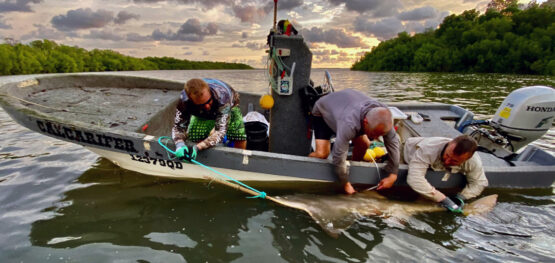
During a trip to the Cape York Peninsula in late 2025, scientists worked alongside commercial fishers to collect tissue samples and tag a 4.2-metre adult male largetooth sawfish (Pristis pristis), which was caught by the fishers at the mouth of the Holroyd River. The animal was fitted with two satellite miniPAT tags to track its movements and depth use. One of the tags was programmed to detach after 60 days and surfaced 48 kilometres northwest of where the sawfish was released, confirming it had survived capture and was moving normally.
Encouragingly, this latest result adds to a growing record of successful tagging events across the Gulf. To date, 21 largetooth sawfish have been satellite-tagged by commercial fishers, with 20 tags transmitting data showing that all animals survived capture and release. One tag malfunctioned from the beginning of the deployment. An adult sawfish tagged earlier in the project travelled more than 1,000 kilometres, highlighting just how far these giants can move across the Gulf of Carpentaria.
“The survival rates we’re seeing are very positive. They demonstrate that, with careful handling, sawfish survive capture in commercial nets. They also show that collaboration between scientists and fishers can deliver conservation benefits for this endangered species.”
Dr Richard Pillans, project leader and CSIRO researcher
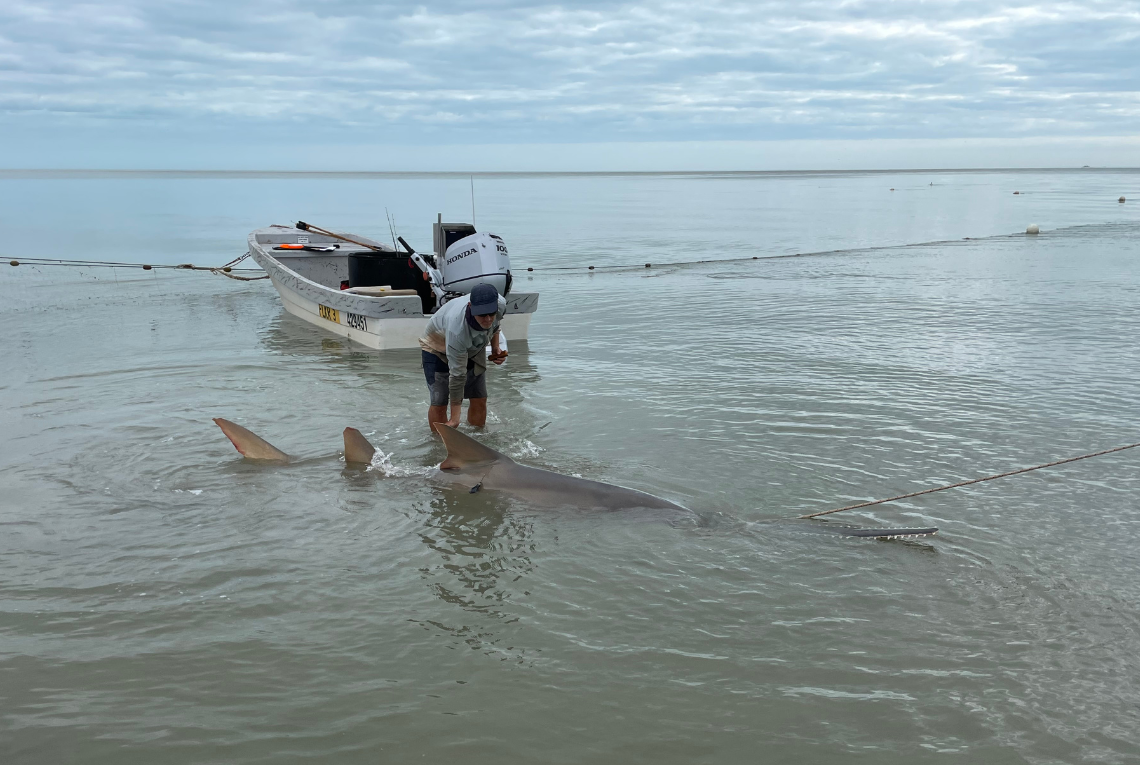
Data from the Holroyd River male also revealed intriguing new insights into sawfish behaviour. The depth sensor data showed the animal frequently changed depth and, somewhat unexpectedly, spent considerable time at the sea surface. In the flat, shallow waters of the Gulf of Carpentaria, such vertical movement indicates that the sawfish was swimming up and down through the water column rather than simply following the seabed contours. These findings suggest that adult largetooth sawfish may be more active in surface waters than previously thought.
The hub project is led by CSIRO and Charles Darwin University in collaboration with the fishing industry and co-funded by the Fisheries Research and Development Corporation. It is helping to fill critical knowledge gaps about sawfish in northern Australia. Understanding how adult sawfish use habitats across the Gulf of Carpentaria is vital for improving conservation outcomes. Adults move between estuaries, rivers and offshore habitats, and their long-toothed rostrum makes them prone to entanglement in nets.
By working closely with commercial fishers and Indigenous groups across northern Australia, researchers are building a clearer picture of sawfish ecology, including their survival after capture, movement ranges and habitat preferences. This information helps to guide fisheries management, bycatch mitigation, and conservation planning.
“Partnerships with industry and local Indigenous groups are essential for collecting high-quality data on these rare species. Commercial fishers are on the water every day and can help us collect data we could not obtain on our own. Each new tag adds to a growing picture of how these iconic animals move and survive across Australia’s tropical waters.”
Dr Richard Pillans, project leader and CSIRO researcher
The project continues to shed light on the resilience and remarkable journeys of these iconic animals, while building strong partnerships among researchers, fishers, Traditional Owners, and management agencies.