
Newsletter
4 September 2026
Welcome to the September 2026 Marine and Coastal Hub offshore wind farm environmental research update. This issue features progress on oceanographic, species and noise modelling for Bass Strait, and a wrap of offshore renewable energy presentations given at the 2026 Australian Marine Sciences Association conference.
Project 4.7 information release on the horizon
Hub Project 4.7 is preparing development scenarios and species distribution, migration and population dynamics models to support a suite of direct impact models for anthropogenic activities in the Bass Strait region.
In coming months, the project team will contact parties who have provided data to the project under data sharing agreements. They will share the initial results of the distribution, migration and population dynamics models and gather feedback on the methods and results.
Once finalised, the species distribution maps and associated model outputs will support stronger collaboration and efficient decision-making for industry, government, and research.
Data sharing in the news
Data sharing accomplished through this project was promoted in a media statement issued by offshore wind project Star of the South last week. Hub Project 4.7 leader Keith Hayes of CSIRO subsequently discussed the project on ABC Gippsland breakfast radio. He said the aggregation of data from a range of sources had allowed a broader understanding of how threatened and migratory species use waters around the Gippsland offshore wind area. See the media release on the SoutherlyTen website.
Modelling the flow-on effects of offshore wind farms
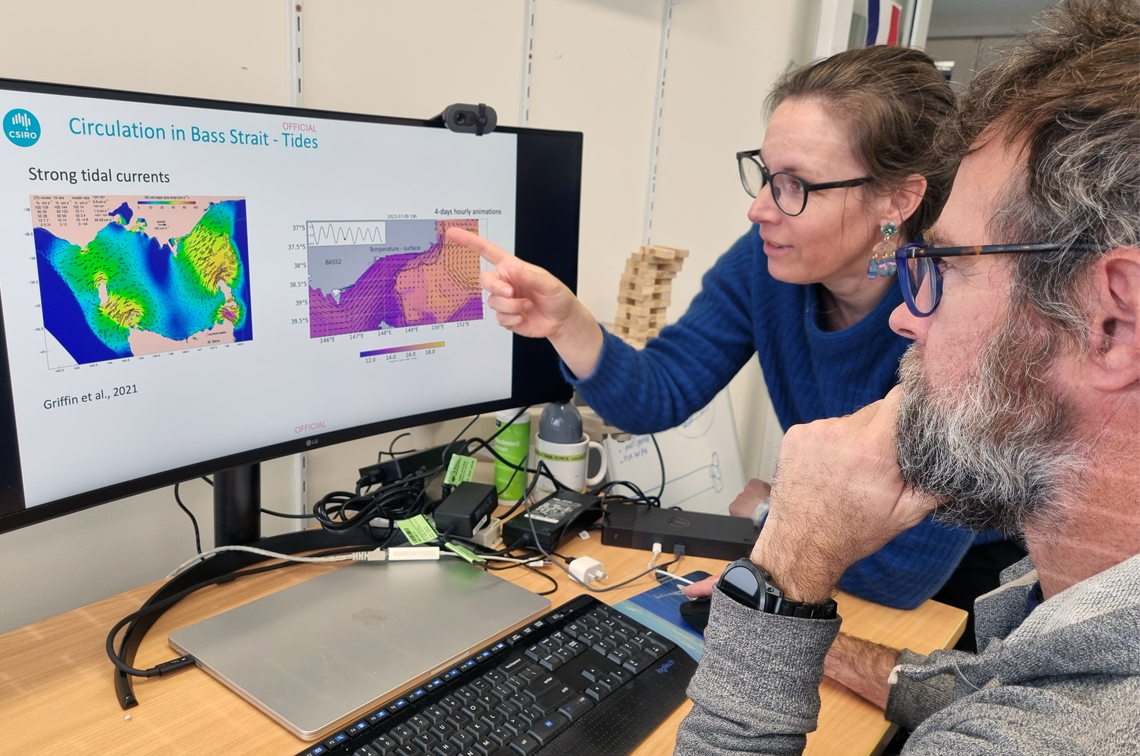
Foundational ‘ocean state’ conditions for this project’s whole-of-ecosystem modelling, population-level modelling, and underwater sound propagation modelling are generated by the Bass Strait Regional Model (Bass2).
Dr Clothilde Langlais and Dr Mathieu Mongin of CSIRO developed Bass2 to model the potential effects of wind turbines on nutrient cycling in Bass Strait under a scenario of wind farm development.
“The dynamical deep ocean provides nutrients for a lot of things that humans care about whether its water quality, fishing, biosecurity, aquaculture,” Dr Langlais says.
“We’re looking at how nutrient delivery from the deep ocean occurs naturally in this region and how offshore wind farming would change this natural cycle. Would it enhance or suppress the nutrient supply?”
Read the full Bass2 story.
Mapping, data management and risk assessment feature in AMSA 2026 offshore renewable energy presentations
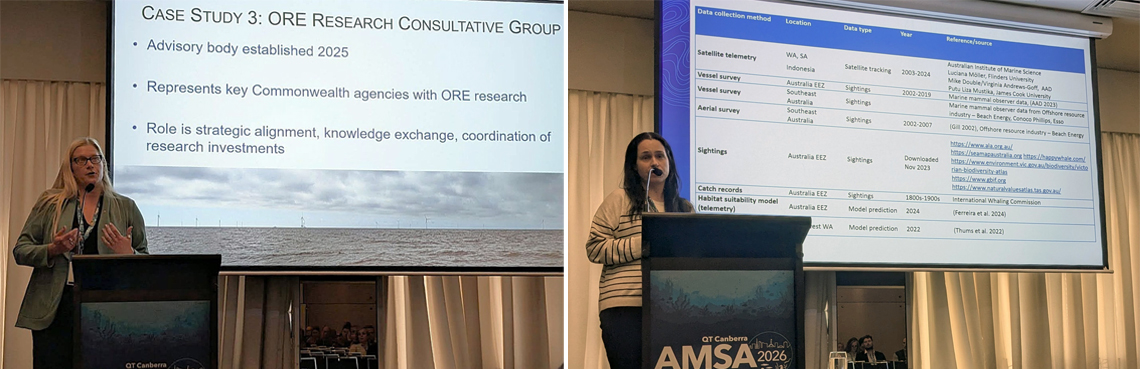
Offshore renewable energy presentations are gathering momentum at the annual conference of the Australian Marine Sciences Association. This overview from AMSA 2026, held at Canberra in August/September, shows the breadth of topics being tackled by the marine research community. It includes projects funded by the hub and the Department of Climate Change, Energy, the Environment and Water Renewables Environmental Research Initiative (RERI).
- Developing better practices to support environmental research for offshore renewable energy in Australia. Presenter: Rachel Przeslawski of Research Connect Blue and the Marine and Coastal Hub. (Marine and Coastal Hub/RERI)
- Exposure of pygmy blue whales to existing threats to inform offshore wind farm development. Presenter: Luciana Ferreira of the Australian Institute of Marine Science. (Marine and Coastal Hub)
- Navigating shared seas: Spatial overlap of seals and offshore wind farms in Southern Australia. Presenter: Marissa Hutchings, South Australian Research and Development Institute (SARDI). (RERI)
- Standardising collision risk assessment for offshore wind in Australia. Presenter: Ashley Potter, Data science and Analytics Consultancy Symbolix. (RERI)
- Global lessons for guidance on benthic characterisation for offshore renewable energy. Presenter: Aero Leplastrier, Geoscience Australia. (RERI)
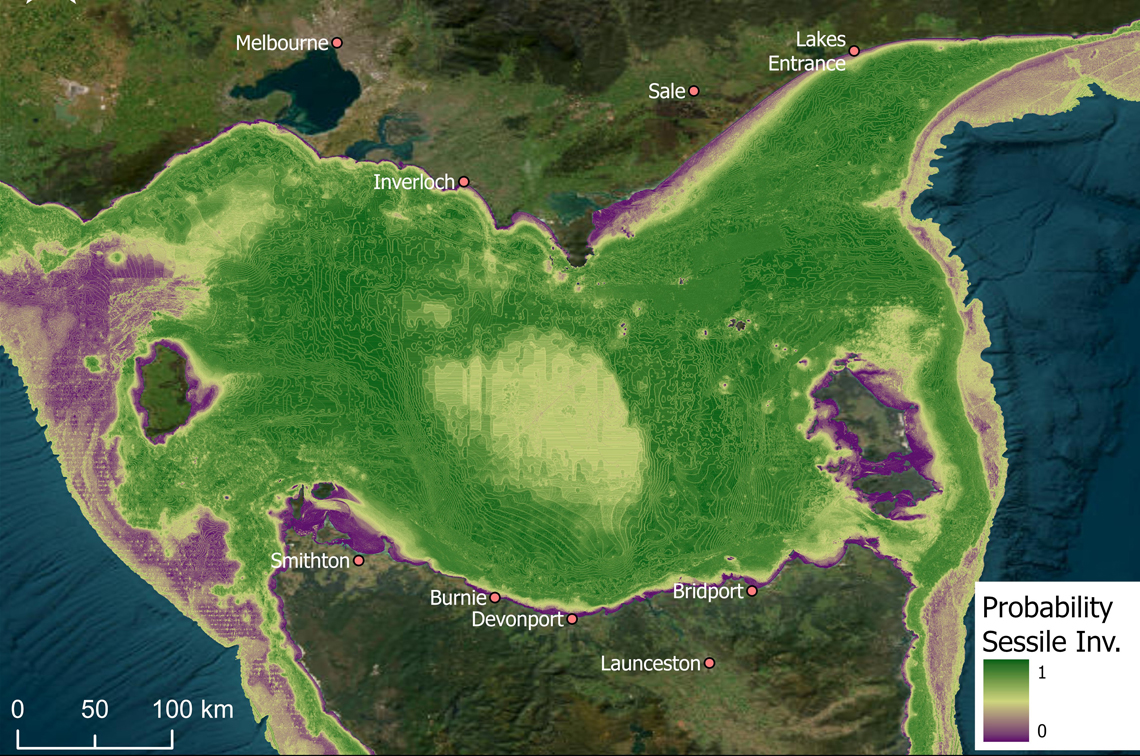
- Mapping seabed geomorphology and benthic habitats for sustainable offshore renewable energy development in Bass Strait. Presenter: Andrew Carroll, Geoscience Australia. (RERI)
- Mapping seabed geomorphology for sustainable renewable energy in Australia. Presenter: Ross Whitmore, Geoscience Australia. (RERI)
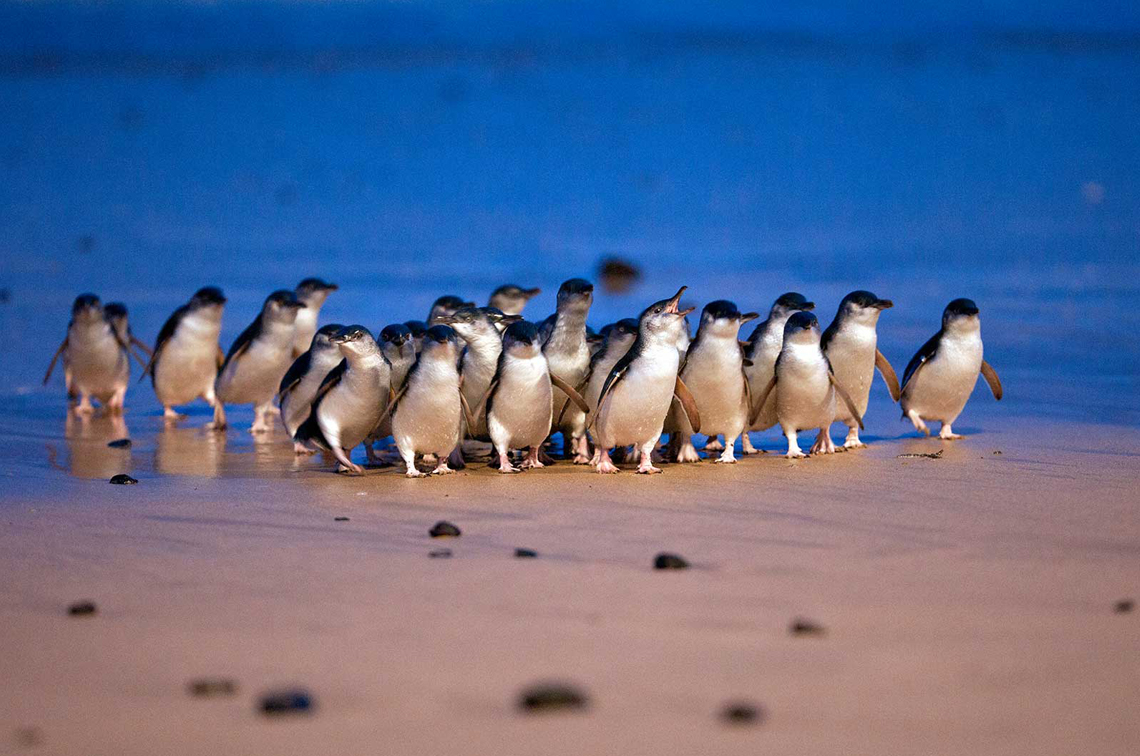
- Translating ecological knowledge of little penguins into practical guidance for offshore wind farm development. Presenter: Hannah Calich, Australian National University. (RERI)
- Data through to information: building Australia’s digital marine commons. Presenter: Peter Walsh, University of Tasmania. (Australian Research Data Commons)
- Reducing the risk: Mitigating offshore wind impacts on marine mammals. Presenter: Jessica Harvey, HiDef Aerial Surveying.
- Increasing data availability for quantitative cumulative impact assessment: a FAIR-secure pipeline for marine environments: Presenter: Harrison Carmody, University of Western Australia.
- Combined hydrodynamic and ecological assessment at a North Sea windfarm. Presenter: Michelle Barnett, Sonardyne International Ltd.
Abstracts are available on the AMSA 2026 website.
Sign up for the update
Visit our home page and scroll down to join the mailing list for this update, and/or the quarterly Marine and Coastal Hub newsletter The Blue Drummer.
Related stories
Newsletter
Marine and Coastal Hub offshore wind farm environmental research update, June 2026
Newsletter
Marine and Coastal Hub offshore wind farm environmental research update, March 2026
Newsletter
Marine and Coastal Hub offshore wind farm environmental research update, December 2025
More stories